- -15%


 Security policy
(edit with the Customer Reassurance module)
 Delivery policy
(edit with the Customer Reassurance module)
 Return policy
(edit with the Customer Reassurance module)
This feature makes the drug a first-line treatment for women with polycystic ovary syndrome (PCOS) and other ovulatory disorders.
Besides its effect on testosterone, the chemical component also influences sperm parameters in men with a low sperm count and other forms of male infertility. The increase in FSH levels promotes spermatogenesis, leading to improved sperm count, motility, and morphology.
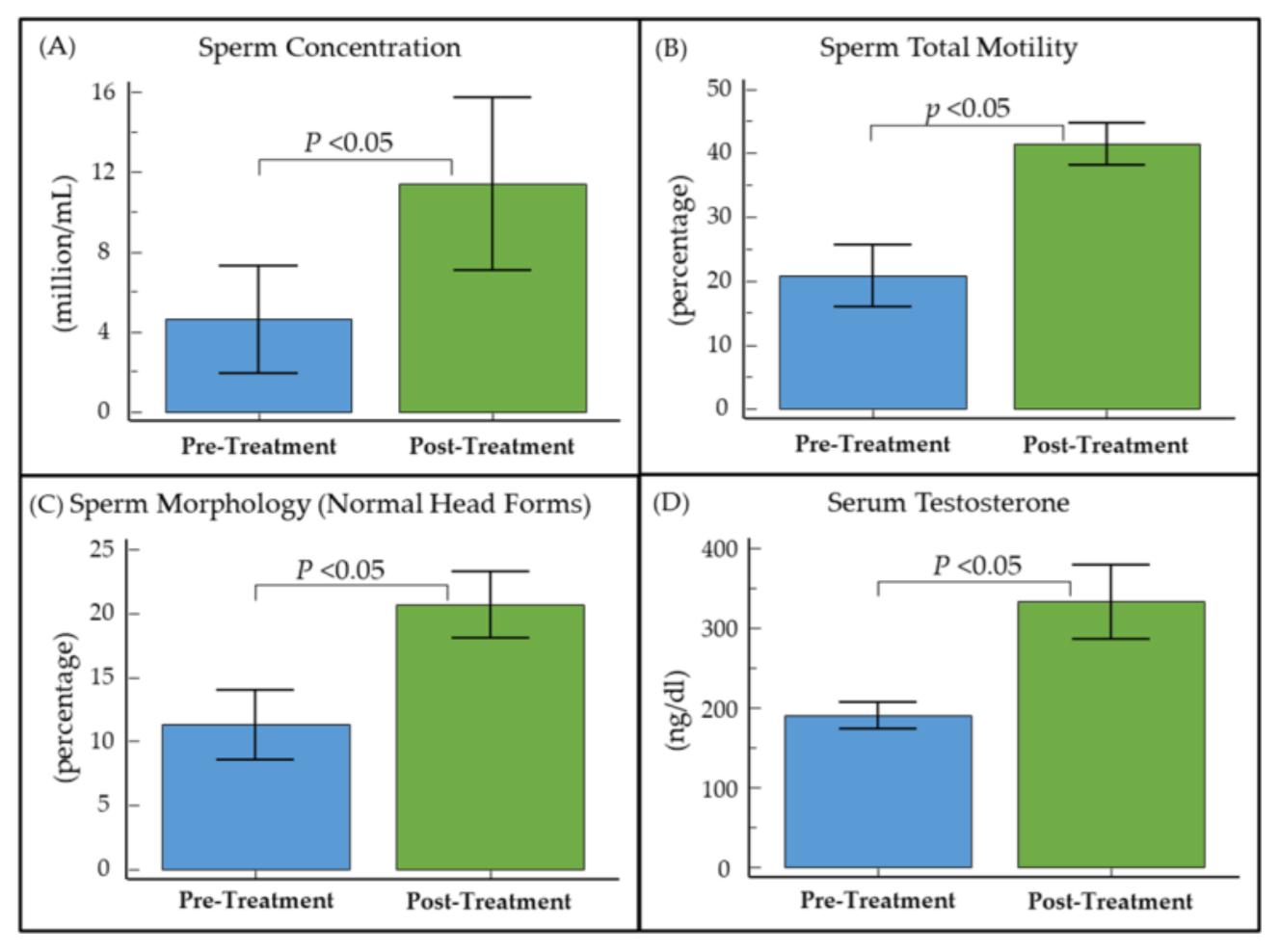
In pictures, you can see pre- and post-treatment (A) sperm concentration, (B) total motility, (C) sperm morphology, and (D) serum total testosterone levels. Patients are oligozoospermia hypogonadal obese men treated with the medication for male infertility.
The ingredient is used in PCT to counteract the suppression of endogenous testosterone production caused by anabolic steroid use. The medication affects gonadotropin release, normalizing the level of testosterone and eliminating the risk of side effects associated with hypogonadism, such as muscle loss, fatigue, and depression.
The mechanism of action of the drug is focused on its ability to modulate estrogen receptors located in the hypothalamus. It acts in both directions, which allows for interfering with the normal negative feedback mechanism.
By entering the hypothalamus, the ingredient causes a chain of reactions aimed at binding with estrogen receptors. This action leads to the suppression of the action of endogenous estrogen. This blockage helps prevent the production of the negative feedback sent as a result of GnRH secretion. This action leads to an increase in the frequency and amplitude of GnRH pulses, which results in improved performance of the anterior pituitary gland.
The increased GnRH pulses stimulate the pituitary gland to secrete higher levels of LH and FSH. These gonadotropins are critical for the regulation of the secretion of female sex glands. If we consider the female organism, FSH is responsible for the development of ovarian follicles, while LH triggers ovulation. Keeping these levels elevated creates more chances for a successful pregnancy. If we talk about the male organism, LH stimulates the Leydig cells in the testes to produce testosterone, while FSH supports spermatogenesis.
The rise in the FSH level in the ovaries leads to the growth and maturation of ovarian follicles. The subsequent surge of the LH level results in ovulation. In the male body, LH stimulates the synthesis and secretion of testosterone in the testes, while FSH acts on Sertoli cells to promote spermatogenesis.
This dual action of the chemical component affects both male and female bodies. The ability to affect sex hormones and cells improves the organism’s fertility and increases the chances of getting pregnant.
Clomiphene Citrate is used for clinical purposes to improve the fertility capabilities of both male and female bodies. The medication helps solve a wide range of reproductive health issues. However, the drug is also used off-label. The primary uses include.
Sports enthusiasts and bodybuilders who consume anabolic steroids frequently encounter suppression of their natural testosterone production. The administration of Clomiphene Citrate helps eliminate this suppression and restore normal hormonal balance during PCT. The ingredient helps activate the HPG axis and increases the level of endogenous testosterone. Moreover, it also prevents the adverse effects of low testosterone, such as muscle loss and depression.
Clomiphene Citrate can be applied to treat hypogonadism in men. It’s a condition characterized by a low testosterone level. The condition can lead to erectile dysfunction, decreased libido, fatigue, and reduced muscle mass. The chemical component encourages the stimulation of endogenous testosterone synthesis by increasing LH and FSH levels.
Clomiphene Citrate can improve sperm parameters, including count, motility, and morphology in men who suffer from idiopathic oligospermia or other forms of infertility. This effect helps increase the likelihood of achieving pregnancy through natural conception or assisted reproductive techniques.
Clomiphene Citrate is primarily designed for the treatment of anovulatory infertility. It’s prescribed to women with polycystic ovary syndrome (PCOS). PCOS is a common endocrine disorder characterized by irregular menstrual cycles and anovulation. The medication contributes to the creation of favorable conditions for natural ovulation, which significantly raises the chances of conception.
The drug has also been tested for treating other conditions, such as gynecomastia in men, and as an adjunct therapy in certain types of breast cancer. Its ability to modulate estrogen receptors makes it a versatile agent in various clinical scenarios.
Clomiphene Citrate is administered orally, and the dosage regimen varies, based on the indication and patient-specific factors. Proper dosing is crucial to maximize efficacy while minimizing potential adverse effects.
In the context of PCT, consumers usually administer Clomiphene Citrate daily. 50 mg per pay for 4–6 weeks is a common dosage. The exact dosage and intake duration can vary, depending on the history of prior steroid use. Consumers should also take into account the individual’s hormonal response. Note that the drug is usually combined with other agents, such as Tamoxifen, to optimize recovery of the HPG axis.
When treating male hypogonadism, the dosage of Clomiphene Citrate can vary widely. Thus, an administration regimen can range from 25 to 50 mg daily or every other day. This strategy helps stimulate stable testosterone production, regulating efficacy and minimizing the risk of side effects. Blood tests are regularly conducted to assess hormone levels and adjust the dosage.
50 mg per day for 5 days is the standard initial dose for stimulating ovulation in women with anovulatory infertility. Note that the administration cycle should start on the 5th day of the menstrual cycle. If ovulation does not occur, it’s possible to increase the dosage to 100 mg per day. 150 mg per day is the maximum recommended dose, as higher doses do not significantly improve ovulation rates but increase the risk of adverse effects.
Clomiphene Citrate tablets are contraindicated in individuals with liver disease, abnormal uterine bleeding, ovarian cysts, or uncontrolled thyroid or adrenal dysfunction. Women who undergo treatment should be under constant monitoring for signs of ovarian hyperstimulation syndrome (OHSS). It’s a serious complication characterized by enlarged ovaries and fluid accumulation in the abdomen. If visual disturbances are noticed, patients should stop taking the drug immediately. Regular monitoring of liver function and hormonal levels is recommended during treatment.
Although the chemical component is generally well-tolerated, some side effects are still observed. These side effects can be categorized based on their frequency and severity. Additionally, certain side effects are gender-specific, i. e. they affect either only men or women.
Yes, tablets are dosed for 25 mg. Depending on the required dosage, patients can take one or several pills.
Clomiphene Citrate comes as the main active ingredient. Other components are supplementary and are used to ensure the stability and better absorption of the chemical ingredient.
It’s recommended to take pills with water for better adsorption.